Babygirl Plays With Her First Bbc Yet Again! I Love Watching He...
This is Going to Hurt: What medical shows become right and incorrect
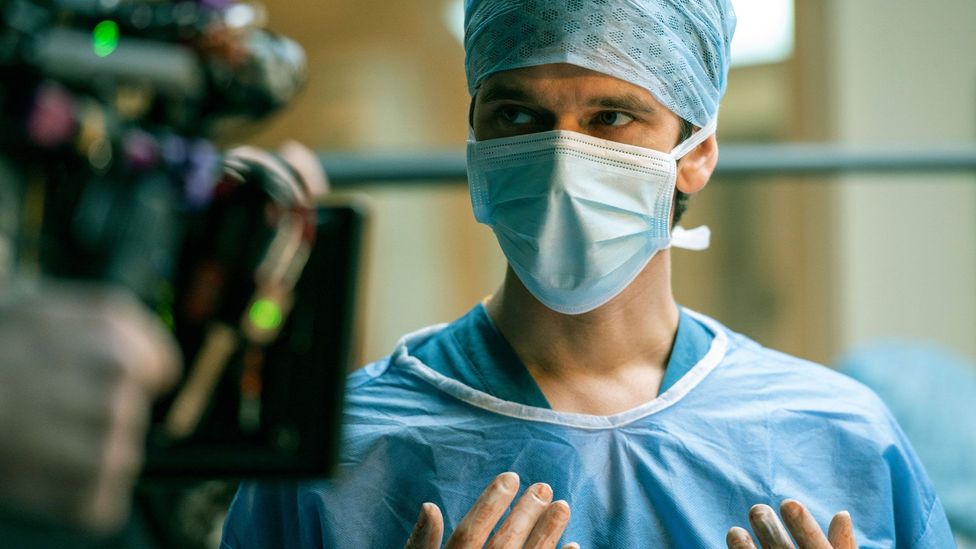
A new BBC/AMC series depicts the exhausting life of a British md with dark one-act. And information technology might be the most realistic hospital drama yet, writes Richard Fisher.
I
In a Chicago infirmary, two doctors are leaning over an unconscious patient, trying to piece of work our what'southward wrong with him. The senior resident looks at his nautical chart. "Partially compensated metabolic acidosis," he observes. They have the man's temperature, and examine his tongue, finding testify of abrasion and a seizure. "Meningitis?" wonders the trainee.
"Yeah, could be. We're going to have to practice a lumbar puncture. You always washed one?" the senior physician asks. "Uh no, but I've seen it done…" "Meet one, do 1, teach one", says the senior dr.. The trainee's eyes widen every bit he realises he's going to have to tap someone's cerebrospinal fluid for the beginning time.
More similar this:
– Tv shows to watch this February
– What is the future of the cop drama?
– Netflix's imitation heiress drama is a striking
And so goes a conversation betwixt resident Marking Greene (Anthony Edwards) and his junior John Carter (Noah Wyle) in the get-go flavour of ER, the 1990s medical drama that spawned many imitators for its realistic depiction of hospital procedures – including lumbar punctures.
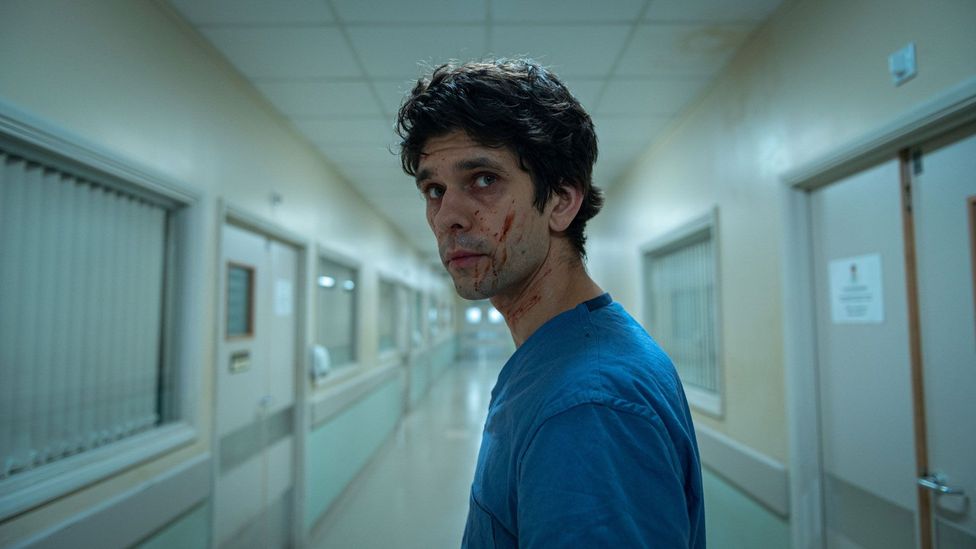
New series This is Going to Hurt is based on former doctor Adam Kay'due south book about his experiences every bit a junior doctor (Credit: BBC/AMC)
Greene's phrase – "see one, practise one, teach one" – sounds like it was coined in the ER writers' room, merely it'southward a existent pedagogy method for training students and junior doctors. It was 1 example of how ER'due south producers managed to integrate a verisimilitude defective from many soapier medical shows, such every bit the long-running series General Infirmary.
I heard the "run into one, exercise one, teach 1" line once again more recently, in the first episode of the new BBC and AMC drama This is Going to Hurt, a punishingly funny portrayal of a British medico'south life on an overworked and underfunded maternity ward in London. Post-obit a morning from hell, the doctor Adam Kay (Ben Whishaw) is asking a naïve trainee (Ambika Mod) if she has always performed a caesarean department. No, she hasn't, she says, but she'southward observed i. "See ane, do 1, teach ane," Kay replies. And certain enough, before long they are both in surgery.
In its setting, procedures and emergencies, This is Going to Hurt has the same authentic dialogue and realism that runs as a thread through many medical dramas these days. Where it aims to differ from others in the genre, though, is in its delineation of simply how exhausting and personally consequential information technology can be to piece of work equally a junior dr. in the UK's free-at-the-point-of-use National Health Service. It also features some extremely rude British doc-sense of humor that you'd never hear from ER's George Clooney.
Does this kind of irreverence brand This is Going to Hurt more "real" than its predecessors? Certainly, it feels like it offers a fresh perspective – merely and then, like any medical drama, in that location are withal some aspects of hospital life that it cannot testify. Watching the series, the question it begs, similar and then many medical dramas before it, is: to what extent is information technology possible to depict "existent" medicine on screen – and what typically goes missing in the translation?
Blurred lines
Television set medical drama has always blurred the line between truth and fiction. The genre can be traced back to the 1950s, with United states of america shows such equally Metropolis Hospital, and Medic. Even then, writers were deploying tricks to amp up the realism. Medic opened with a brusk introduction by an apparently real md (it was an actor) who described the illness or affliction underpinning the story that followed, as if it was a case study in a scientific lecture. It likewise featured a dedication to "the profession of medicine, and the men and women who labour in its crusade".
Over the following decade or so, producers across various medical shows employed – and advertised – their use of medical consultants to supposedly lend expertise. These advisors continue to offer pointers to writers to this day – with arguably mixed results. In do, it is often more about fact-checking specific medical claims rather than screening out unrealistic plotlines.
Plenty of medical dramas since then may seem to accept dispensed with realism, embracing ever-wilder and soapier storylines. Simply at the same time, Television set writers have long known that rooting their fiction in apparently true-to-life medicine lends their stories extra resonance – and the real world has continually offered new sources of inspiration besides. The medical literature is full of boggling instance studies that need simply be lightly fictionalised to work equally entertainment, and every physician or nurse has at least one story about a patient that would exist ripe to be televised.
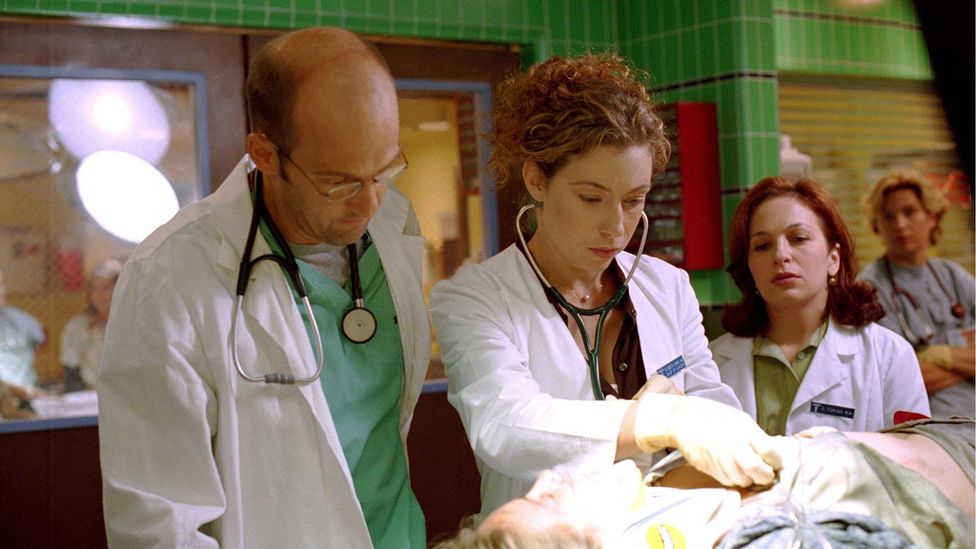
ER set up a new standard for realism in TV medical drama – but it still had a real-life dr. contemplating legal activeness for its inaccuracies (Credit: Alamy)
In the mid-1990s, the US show ER took actuality one step farther. Entwined with its stories of romance and disharmonize, the drama depicted a hospital emergency room facing the social issues of its inner-city location in Chicago, with a camera that did not shy away from the grisly and bloody details of the wounded or the ill. The writers besides introduced complex medical jargon into the scripts, making few concessions to the not-medically trained audition – nor, for that affair, the actors. To help him think all the arcane medical vocabulary, Clooney – playing the graphic symbol Doug Ross – plainly wrote his lines on patients' bedsheets or his clipboard, out of view of the camera.
ER was so plain accurate that it began to feed back into the instruction at medical school: educators would play clips from the prove in classes to teach students about constructive patient interaction. Every bit the doctor Ellen Lerner Rothman wrote in a memoir about her preparation at Harvard Medical School, ER was hugely influential for her and her fellow students: "Through the ER physicians, residents, and medical students, my classmates and I explored who nosotros wanted to be and what we were afraid we might become. We developed a prototype for how nosotros wanted to answer to our patients and explored how nosotros would feel if we were unable to uphold information technology in the real world."
That said, ER might have had the jargon and realistic gore, but the stories were not completely true to life. The departures from reality ranged from the benign to the fantastical. Like all medical dramas, the writers had to apply time compression to make patient arcs fit into a single episode: the results of claret tests, for example, normally take days to come dorsum, not hours. Single doctors performed an array of tasks that would, in reality, be shared between a team; patients unduly survived cardiac arrests, trainees led complex surgeries, and the actors unwittingly did things like mishandling blood samples that would make for a devil-may-care infection risk. And and so of form in that location were the movie-star expert looks and helicopter crashes right outside the infirmary forepart door.
Indeed, before long afterwards ER premiered in 1994, the producers decided to modify the proper name of the fictional Chicago hospital it was set at from Cook County Full general hospital to simply "Canton Full general", afterward the head of emergency medicine at Chicago'south existent-life Cook County Hospital complained to the showrunners and investigated legal action, so bellyaching was he at the show's inaccuracies.
Of course, ER has been far from alone in its departures from existent life. Some medical dramas take gone quite a bit farther. Greyness's Anatomy would be 1 example of a show where no viewer could ever believe they were watching events from a real infirmary. At least, you would hope so: plotlines include the time Cristina (Sandra Oh) got impaled by a falling icicle outside the hospital, or the notorious musical episode when the characters broke into vocal. The writers, however, have drawn on real-life medical case studies for their stories. Episodes where Meredith Grey (Ellen Pompeo) and her colleagues come across a girl immune to pain, or a woman who had several spontaneous orgasms per twenty-four hour period were based on accounts of real patients.
Where TV writers accept really taken liberties, though, is over the depiction of doctors' professionalism, or lack of it. A squad of medical researchers led by Lindsey Ouellette at Michigan State University recently watched 271 episodes of primetime hospital drama, including ER, Grey's Anatomy, House, Nurse Jackie, and 12 others, and observed more than 1,000 private examples of unprofessional behaviour among the fictional doctors and nurses in the shows. "Although Television receiver dramas often promoted emergency medicine clinicians as heroes interim in the best interests of their patients, the episodes likewise offered story lines in which physicians were morally corrupt, racist, arrogant and uncaring toward each other, staff, and patients," write Ouellette and colleagues.
Another study, focusing on Firm and Grey'due south Beefcake, was similarly critical, finding "egregious deviations from the norms of professionalism" in the storylines. These included the failure to get consent from patients for treatments; the fact that many of the physicians were in some sort of sexual relationship with one another; and a litany of disrespectful interactions betwixt colleagues that would normally state the doctors in trouble with Hr. Possibly unsurprisingly, Gregory Business firm (Hugh Laurie) was the main culprit of the latter in his evidence, responsible for 88% of insulting or unprofessional encounters with colleagues and patients.
It may seem like these researchers were missing the point – considering, after all, if TV protagonists did everything by the book, it would be rather boring to watch. But the reason they conducted the studies was their worry that inaccurate depictions on screen could spill out into how people come across doctors and nurses in real-world care. "The scripts of these shows use technically accurate terminology, creating a greater sense of authenticity," write Ouellette and colleagues. "Because these shows appear realistic in many respects, the line betwixt fact and fiction is blurred."
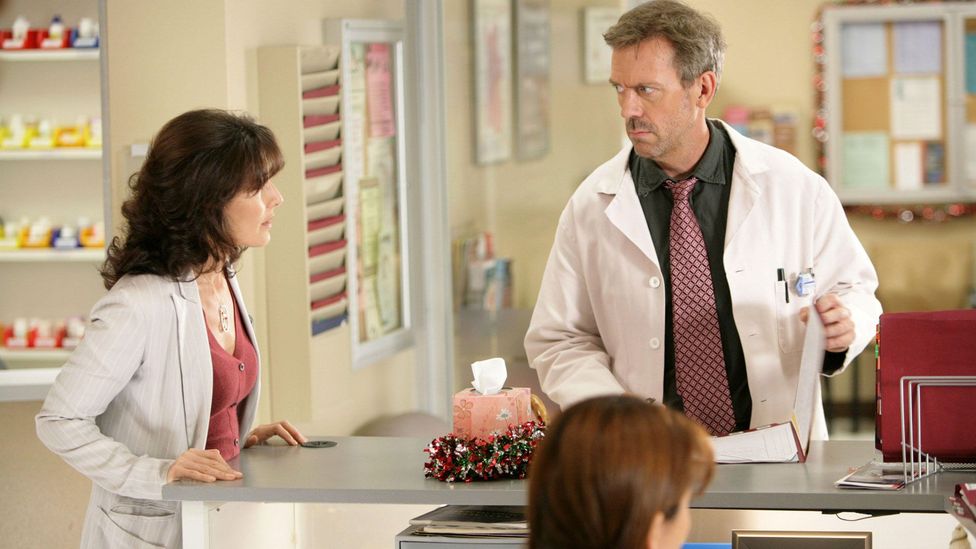
Hugh Laurie's Gregory Firm was 1 of the most famously unprofessional TV medics (Credit: Alamy)
Whether bad behaviour on screen is actually so large a problem, however, is unclear. Surprisingly, there is some show that watching medical dramas might actually enhance viewers' trust in real-earth medical staff. And it might be argued that medical dramas, collectively, can inform audiences about the workings of worlds that they might otherwise not come across unless they are ill, helping to humanise the doctors and nurses that work within them.
Pressure level viewing
In terms of humanising the realities of hospital life, watching This is Going to Hurt certainly worked for me. It's a type of medical drama more than rarely seen on screen: for one matter, information technology shows just how unflinchingly exhausting and thankless the job of a medical professional can be. In more conventional hospital dramas, the antagonists are usually colleagues, patients, disease or the wounded torso – these are all present, but the primary foe that Kay is upwardly against is the healthcare organisation itself. Under-funded and nether-staffed, information technology threatens to drain everything from those toiling within it. There'southward non a hint of glamour or nobility to this piece of work.
The viewer lands in Kay's visceral world almost immediately. He wakes upwards unshaven and wearied in his car outside the infirmary, before stumbling in late for piece of work. Direct away, he encounters a woman in deep pain downwards an alleyway on the infirmary grounds, experiencing an umbilical cord prolapse. Minutes later, he is kneeling over her as she is wheeled to an emergency c-section, calling for assist from nurses and doing what he tin can to save her infant's life.
"Generally you're sailing the send solitary," Kay explains in a moment of introductory exposition. "A ship that'south massive and on fire and no one'southward had the time to teach you lot how to canvas. It's literally life or death here. You're constantly beingness splashed by bodily fluids – non even the fun kind."
The anarchy continues throughout his shifts, with a tired Kay at diverse points insulting patients, botching procedures, and making poor medical judgements. All the while, he's managing relationships on the outside that he's too wearied and fourth dimension-poor to requite his attending. One moment, he's inserting a scalpel into flesh; the next he's on the phone to his partner and a friend, promising that he'll fulfil his commitment to nourish a stag practice that evening. As Kay's mates booze it upward in a pub, cajoling him to come bring together them, they seem totally discrete from the realities of his work.
And then is This is Going to Hurt more real than other medical dramas? Information technology'due south hard to tell. What makes the layers of truth and fiction more hard to unpick is the testify's writer. It draws heavily on the experiences of the existent Adam Kay – the erstwhile doctor who wrote the script, which in turn was based on Kay's 2022 non-fiction book near his actual experiences in the NHS. Readers volition recognise many of the same scenes, patients and jokes.
When a journalist in 2022 asked Kay about whether the events in his book were true, he said the stories were "reasonably accurate". Total truth, he explained, would have been unethical. It'due south too worth pointing out that Kay's NHS is more than than fifteen years erstwhile, based on experiences dating back to 2006.
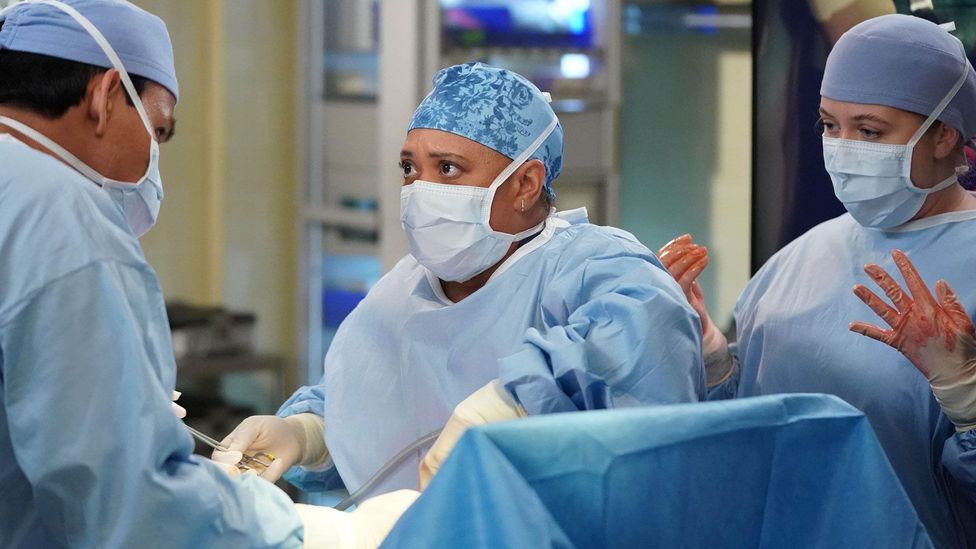
Greyness'due south Beefcake is among the medical dramas that has centred the pandemic in its narratives (Credit: Alamy)
In the translation to television, Kay has surely had to brand concessions that depart from a truly realistic depiction of an NHS hospital in the nowadays day – or at least, his own feel. Unlike the book, which is written in fragmentary diary entries spanning many months, Kay'southward experiences are woven together into episode-long arcs. The anecdote-and-punchline fashion of the book is gone, and therefore dissimilar patients are glued into single people. Notably, too, some of the book'due south sharpest doctor-humour has been toned downward for mainstream television. Not much – information technology's still very rude – but a little.
Missing nihilism
Kay is of form not the only doctor who has adjusted their medical feel for the screen. I asked the screenwriter Dan Sefton, a still-practising doctor, how he translates what he knows about medicine into fiction. He doesn't write memoir like Kay, just equally a TV writer and co-founder of the production company Seven Seas, he has occasionally weaved his lived feel into various Britain medical dramas, including The Practiced Karma Infirmary, Trust Me, and episodes of Casualty, Doctors and Holby Urban center.
What does he think is missing from infirmary drama? His answer surprised me, because it had little to do with bug like medical accuracy or professionalism.
"The experiences that take stuck with me most profoundly as a doctor is the sheer nihilistic pointlessness and unfairness of information technology. That there is no reason, no meaning, for why somebody gets sick and dies," he explains. "If yous tried to portray the reality of information technology, the cold reality, nobody would want to see it."
About medical dramas, he continues, offer an antitoxin to that bleakness of real life. "They're trying to brand even death seem meaningful. The ones that are successful, or at to the lowest degree, the emotionally warm ones, are well-nigh making sense of these painful experiences and trying to build them into a narrative.
Daniela Lamas, a doctor and screenwriter, reached similar conclusions when she wrote for the Usa series The Resident. "At kickoff I worried that I made the televised version misleading," she recalled in the New York Times. "But the accurate cadre of uncertainty – how we residual risk and do good and the great complexity in making decisions near allocating a express resource – is still in that location. And I like believing in an alternate reality where my patient might accept lived. This was the earth we had hoped for. And in the writer's room we were able to make that world come to life.
"Goggle box finds a way to offer plenty reality to teach and to provoke, but likewise offers a balance. Viewers can come close to the fire but they are not scorched."
Sefton as well points out that audiences come to mainstream medical dramas with sure expectations of doctors, which can influence the characters that writers choose to create or non. For example, it'southward rarer to come across a fictional doc or nurse who is not seeking to heal. Fifty-fifty House, for all his anti-hero flaws, was trying to save people's lives. "The idea that your doctor is not a selfless sort of saint, who's got your all-time interest at heart all the time and who goes dwelling worrying most you…that'due south quite disturbing," says Sefton. "I call up people discover the idea of doctors not beingness perfect really very threatening."
Despite this, Sefton wonders whether, post-Covid, at that place may now be space for more nuanced depictions of hospital life, like This is Going To Hurt. The pandemic, he suggests, has too opened a lot of people's eyes to the pressures on health systems similar the NHS. "The truth nearly the NHS is that it is a poorly-funded adequate wellness service, from a global perspective," he says. It'southward neither the all-time health provision in the globe, nor the worst. "The distressing truth is somewhere in the middle: extremely expert value, kept going past lots of hard work by some defended people."
The pandemic's impact on US hospitals already seems to be feeding into the plotlines of American medical drama. A recent scientific report of sixty episodes of The Good Medico, Grey'southward Anatomy, Chicago Med, The Resident and New Amsterdam aired betwixt Nov 2022 and May 2022 found that half (35 episodes) included the pandemic or its consequences in their narratives. "The medical dramas all focus on the psychological effects of the pandemic in wellness intendance workers, showing their exhaustion, feet, anger, and fear," writes Irene Cambra-Badii of the University of Vic, Central University of Catalonia and colleagues. While acknowledging that these series contain factual inaccuracies, the researchers conclude that showing such psychological hardship could exist helpful for educating medical students and the public about the realities of treating Covid-19 inside US hospitals.
Ultimately what matters to Sefton when he writes medical drama is stories that are emotionally truthful. The question of whether medicine itself is accurately depicted is a distraction.
"If you're looking for adept medical advice from medical shows, so I think you're delusional," he says. The best medical drama is accurate in a different manner: "They're all stories near life, decease, the risk of it, or love. Very simple profound things. That'south why people scout it. They don't picket it for wellness information."
This is Going to Hurt is bachelor now on BBC iPlayer in the UK and will be premiere in the US on AMC soon.
Love picture show and TV? Join BBC Culture Motion picture and TV Club on Facebook, a community for cinephiles all over the world.
If you would like to comment on this story or anything else you have seen on BBC Culture, caput over to our Facebook page or message u.s. on Twitter .
And if you lot liked this story, sign up for the weekly bbc.com features newsletter , called The Essential Listing. A handpicked selection of stories from BBC Future, Civilisation, Worklife and Travel, delivered to your inbox every Friday.
Source: https://www.bbc.com/culture/article/20220209-what-tv-medical-shows-get-right-and-wrong
0 Response to "Babygirl Plays With Her First Bbc Yet Again! I Love Watching He..."
Post a Comment