How Many States Are Reviewing Abortion Laws in 2019
This is Office Two of Stateline's 2019 Legislative Review.
More state abortion laws were enacted this year than at whatever time since 1973, the year the U.South. Supreme Court decided in Roe v. Wade that women have a ramble right to end their pregnancy.
Many of the new laws — either banning or protecting the right to abortion — came in reaction to President Donald Trump'southward second nomination of a conservative justice to the high court, creating the possibility that the historic abortion rights decision could be overturned.
The new ballgame bans in red states and laws affirming a woman's right to an abortion in blue states are considered by legal experts to be largely hypothetical since nothing will change unless Roe v. Wade is overturned.
Still, ballgame rights advocates consider this yr's attack on reproductive rights far from symbolic.
"Information technology's a coordinated strategy to overturn Roe and ban abortion," Alexis McGill Johnson, acting president and CEO of Planned Parenthood, wrote in an email to Stateline. "The threat to our rights and freedoms is non a hypothetical."
Anti-abortion advocates also maintain that the bans have had a practical effect. Co-ordinate to Clarke Forsythe, senior counsel for the anti-abortion system Americans United for Life, the new laws have garnered media attention that has had a "salutary" issue past educating the public.
Likewise sweeping affirmations of women's reproductive health rights, a few blue states enacted measures this year that will accept an immediate effect on women seeking an abortion, making access easier and more affordable.
Only i notable anti-ballgame police that may accept an immediate effect on women passed this year, extending a waiting period for ballgame in Arkansas. That'due south far fewer than in the past few years, in role because of a 2015 Supreme Court finding in Whole Adult female's Health five. Hellerstedt that certain restrictions on abortion facilities represent an "undue burden" for women seeking an abortion.
And so far, most abortion bans enacted this twelvemonth have been enjoined by federal courts. And the others, which aren't slated to take upshot until later this year or in 2020, are under courtroom review.
If the U.S. Supreme Court accepts whatsoever of the more than twoscore other state abortion lawsuits already nether review in federal courts, and if justices decide to reverse Roe v. Wade, this year's sweeping new ballgame bans could take consequence, creating a patchwork of land ballgame laws that would look much like the one that existed earlier 1973.
But expert opinions on the likelihood of that happening are mixed.
Concurrently, the new laws take widened the gulf betwixt red and blueish states on the abortion effect.
"For a long time, y'all saw a lot of activeness in bourgeois states, but liberal states were content with the status quo in abortion policy," said Michael J. New, an associate scholar at the Charlotte Lozier Constitute in Washington, D.C., an anti-ballgame research group.
"At present, we're seeing a big shift in Democratic initiatives in us, with some states ensuring funding and removing previous abortion restrictions," he said. "Republicans, on the other hand, have gradually and steadily moved toward more than extreme country efforts to protect the unborn over the last two decades."
Elizabeth Nash, a policy analyst at the abortion-rights Guttmacher Establish, agrees. "The Supreme Court is looming large over these state debates. The last fourth dimension that people idea Roe was in this kind of jeopardy was the early 1990s. That's the only other time we saw Democratic-led states prefer protections for abortion."
Bans and Affirmations
Eleven Republican-dominated states — Alabama, Arkansas, Georgia, Indiana, Kentucky, Louisiana, Mississippi, Missouri, Northward Dakota, Ohio and Utah — enacted outright abortion bans, largely to spur lawsuits that might prompt the Supreme Court to reconsider its 1973 ruling. None of the laws would have event unless the court reverses Roe v. Wade. Federal courts have blocked them.
Tennessee, which is likewise Republican-controlled, enacted a so-called trigger police force that would ban abortions only if Roe v. Wade is overturned. Trigger laws, already on the books in 7 other states, are non unconstitutional and, therefore, are not bailiwick to federal lawsuits.
All 12 states already had laws that banned abortion in some cases, as well every bit trigger laws and extensive regulations making it hard for abortion clinics to operate. The new laws are intended to renew those states' political intent to outlaw abortion likewise every bit to spur a high court review.
"In nearly cases, bourgeois legislators, seeing a shift in the Supreme Courtroom, want their land to be part of a wave of court cases," Nash said. "There's also a bit of posturing and jockeying for position as a very bourgeois state."
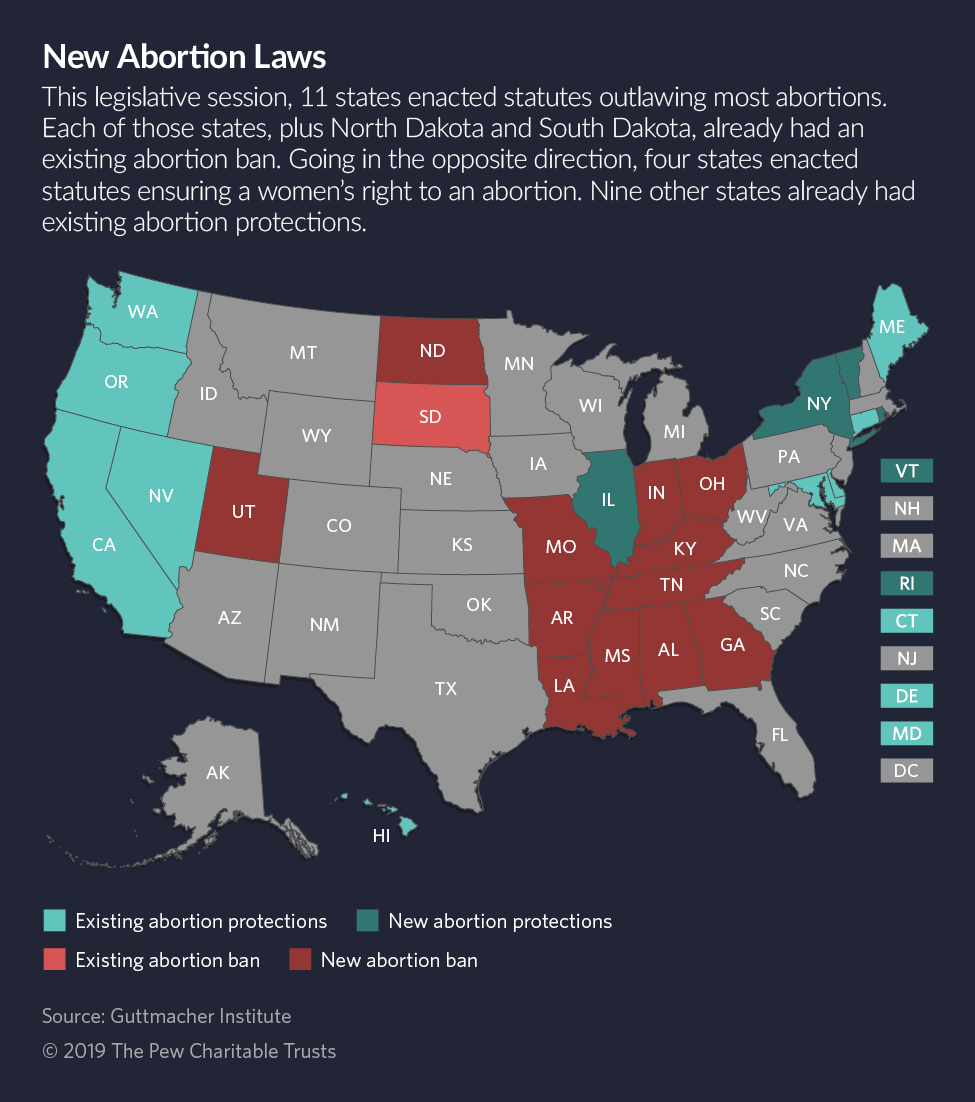
Meanwhile four Democratic-led states — Illinois, New York, Rhode Island and Vermont — enacted new laws affirming a woman's fundamental correct to abortion. Those laws were intended to indicate the state's intent to defend a woman's right to abortion if Roe 5. Wade is overturned, Nash said, while making it harder for politicians to diminish those rights.
They join nine other states — California, Connecticut, Delaware, Hawaii, Maine, Maryland, Nevada, Oregon and Washington — that enacted laws affirming a woman'due south right to abortion as early every bit ii decades ago and still have those laws on the books.
More Than Symbolic
In addition to establishing a adult female's right to ballgame, New York's new constabulary, the Reproductive Health Act, repealed a statute that prohibited anyone only a medical doctor from performing an abortion and removed some restrictions on late-term (after 24 weeks) abortions. The land as well eliminated a requirement that parents must consent to an abortion performed on their daughter if she is a minor.
Maine, which shifted dorsum to a Autonomous-led government this twelvemonth afterwards eight years nether a conservative Republican governor and GOP-led legislature, enacted laws allowing nurse practitioners and doctor assistants to perform the procedure and requiring Medicaid to encompass abortions for low-income women.
Illinois enacted a law repealing previous restrictions on late-term abortions and a requirement that a adult female'south spouse consent to an abortion, as well as other abortion restrictions. The new law as well requires private insurers to cover abortions.
Nevada repealed a statute that had imposed criminal charges on an ballgame practitioner who failed to follow land regulations.
Massachusetts legislators are still considering a bill known equally the ROE Human activity that would eliminate parental consent requirements and expand the circumstances under which a adult female could receive a tardily-term ballgame. Republican Gov. Charlie Baker has said he opposes the bill, but women's health advocates say that could modify.
Legal Challenges
Lawsuits confronting most abortion bans already have been filed in state courts past women's health advocates, including Planned Parenthood, the Centre for Reproductive Rights, the American Civil Liberties Union and other groups. The American Medical Association also has filed lawsuits confronting land laws information technology says would interfere with the patient-medico human relationship.
"It'south extremely disturbing that many states are doing whatever they can to push abortion out of attain," said Jennifer Dalven, who heads the Reproductive Freedom Project at the American Civil Liberties Union. "We expect the courts will block all of the state bans enacted this year. These laws are not only unconstitutional, but they are not what the public want."
According to a May poll by CBS News, two-thirds of Americans want Roe v. Wade to remain in place, while a majority desire some restrictions. More Democrats than Republicans tend to back up abortion rights merely a June poll from NBC News and The Wall Street Journal establish that a majority of Republicans (52%) said Roe v. Wade should non be overturned.
Supreme Court watchers disagree well-nigh the likelihood of the high court accepting a case that would test Roe v. Wade anytime before long, with few predicting the console would overturn it. Near experts say the court is more probable to undermine the protections in Roe over time by upholding more abortion restrictions.
With public opinion trending against the reversal of Roe v. Wade, Forsythe said he thinks the total bans enacted this year are less likely than more moderate laws to trigger a Supreme Court ruling on its landmark abortion decision.
Since Justice Brett Kavanaugh joined the Supreme Court in October, the panel already has declined two country abortion cases.
In May, the loftier court refused to hear a case involving a 2016 Indiana law that would ban abortion based on gender or certain disabilities, including Down's syndrome. And in June, it refused to accept a case brought past Alabama seeking to reinstate a 2016 ban on the standard of care for 2nd-trimester abortions, called dilation and extraction, which likewise is used after some miscarriages.
Although the high courtroom is non obliged to requite its rationale when it refuses to consider an entreatment from a lower court, legal analysts say the justices' refusal to take upwardly either of those abortion bans indicates an unwillingness, at least in an election twelvemonth, to accost the result.
Currently pending before the high courtroom are ii additional abortion cases. One involves a 2016 Indiana law requiring that a woman be shown ultrasound images before getting an abortion. Another involves a 2014 Louisiana law requiring doctors who perform abortions to have admitting privileges at a nearby hospital.
"I tin't imagine how you could draft a new law that is so different from the xl-plus cases in the courts right now that information technology would create a novel examination case for Roe v. Wade," Forsythe said.
Alabama Spotlight
Alabama made national headlines this year, enacting the most extreme anti-abortion legislation in the country. Known every bit the Alabama Human Life Protection Act, the police force would go far a felony for a doctor to perform the procedure at any time during a pregnancy, with no exceptions for rape or incest. The law was scheduled to take effect in Nov but has been challenged in court.
Republican Gov. Kay Ivey, after signing the police, issued a statement proverb, "To the bill's many supporters, this legislation stands every bit a powerful testament to Alabamians' deeply held belief that every life is precious and that every life is a sacred gift from God."
The bans in Alabama and elsewhere "are causing confusion and fearfulness amidst patients," Nimra Chowdhry, country legislative counsel at the Center for Reproductive Rights, told Stateline in an email. "Many of our clients in these states have had patients calling them, asking if they are still able to obtain abortion services in their state."
In May, afterwards the Alabama legislature passed the abortion ban, reproductive rights advocates chartered a plane to fly a imprint over the state Capitol in Montgomery that read: "Abortion IS OK!"
But fifty-fifty if advocates are successful in convincing people that Alabama's new constabulary doesn't make abortion illegal, information technology even so casts a pall over women who are faced with the decision, said 29-year-old Alabama native Bekah Turner, a yoga instructor in Auburn.
"It's left us feeling more than and more unsafe being in a female trunk, and we have a sense that our rights take been handed over to the state."
Among her friend grouping, Turner said, she's hearing talk nearly leaving the state because of the new law. "There's a lot of fear about what the consequences could be in the future. In Alabama, information technology's a social taboo to even talk nigh abortion.
"When you add the unsaid morality around this new law, it makes the shame and stigma of abortion even heavier. We're talking nigh an existential result for women, because if we can't own our bodies, how tin can nosotros feel safe here?"
Source: https://www.pewtrusts.org/en/research-and-analysis/blogs/stateline/2019/07/30/new-laws-deepen-state-differences-over-abortion
0 Response to "How Many States Are Reviewing Abortion Laws in 2019"
Post a Comment